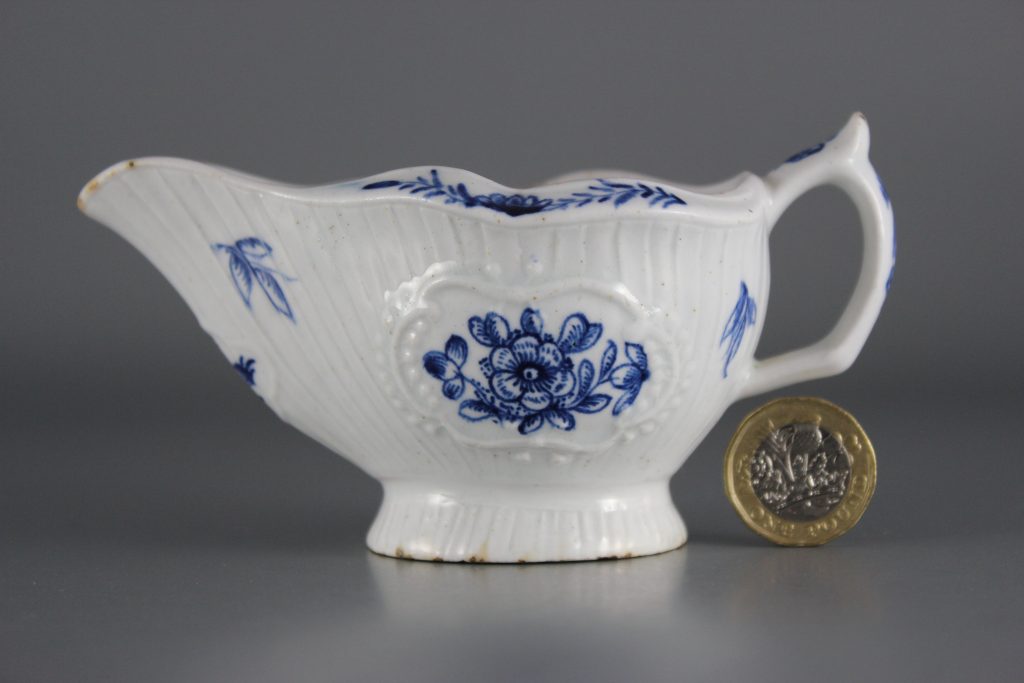
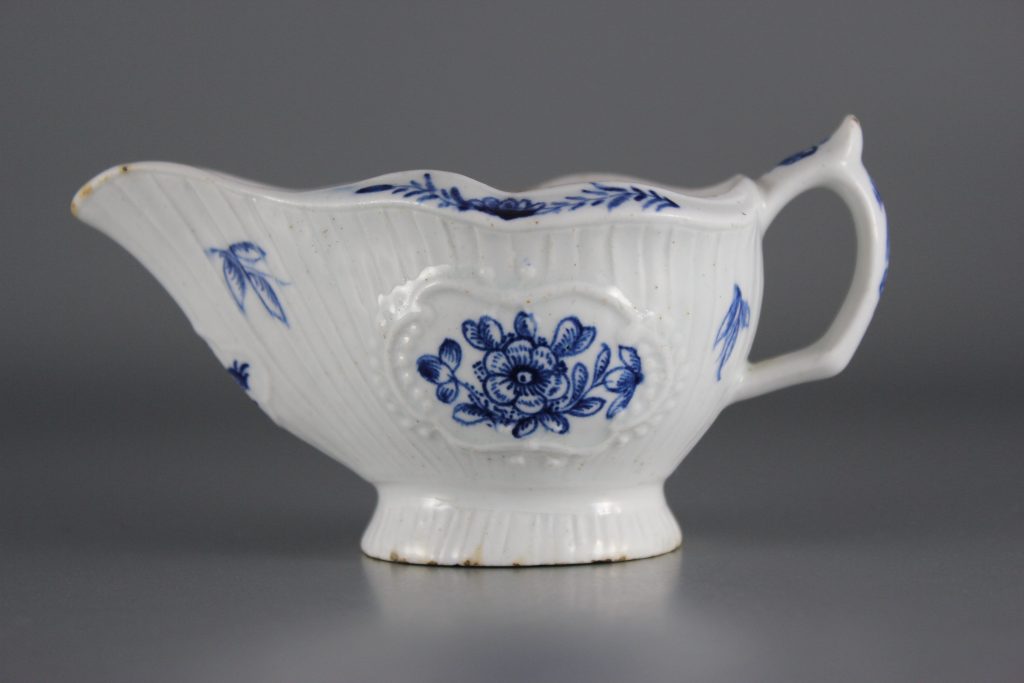
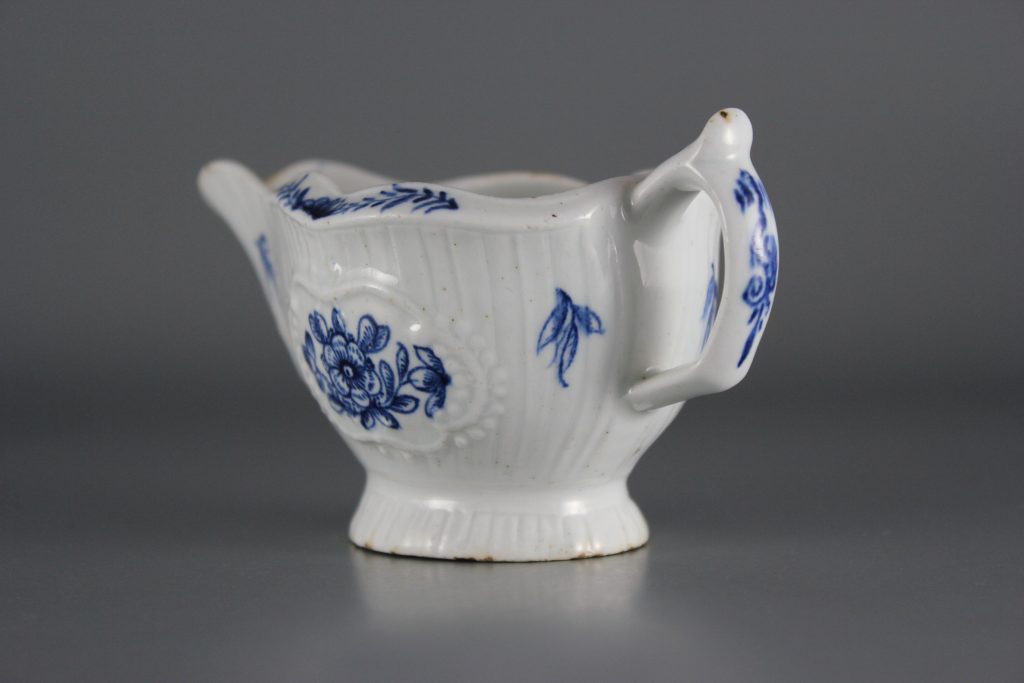
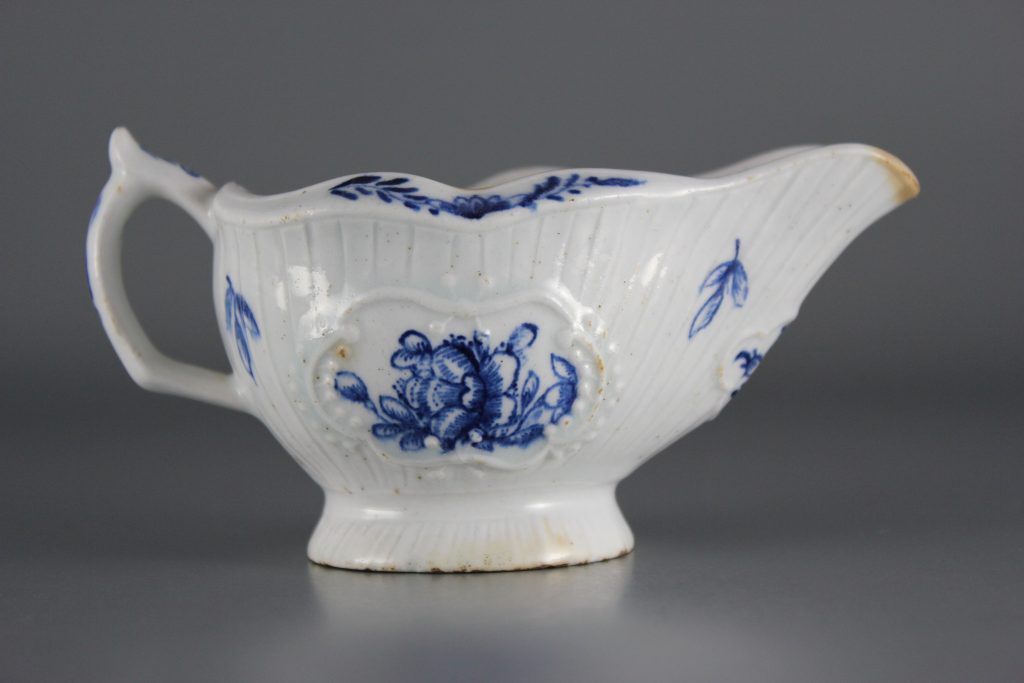
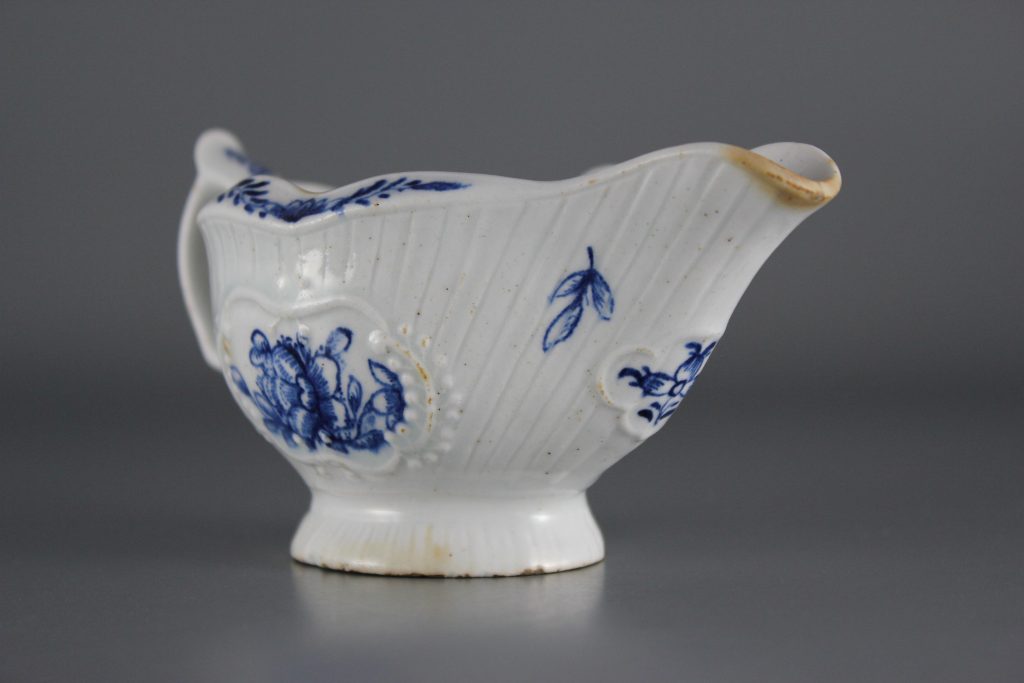
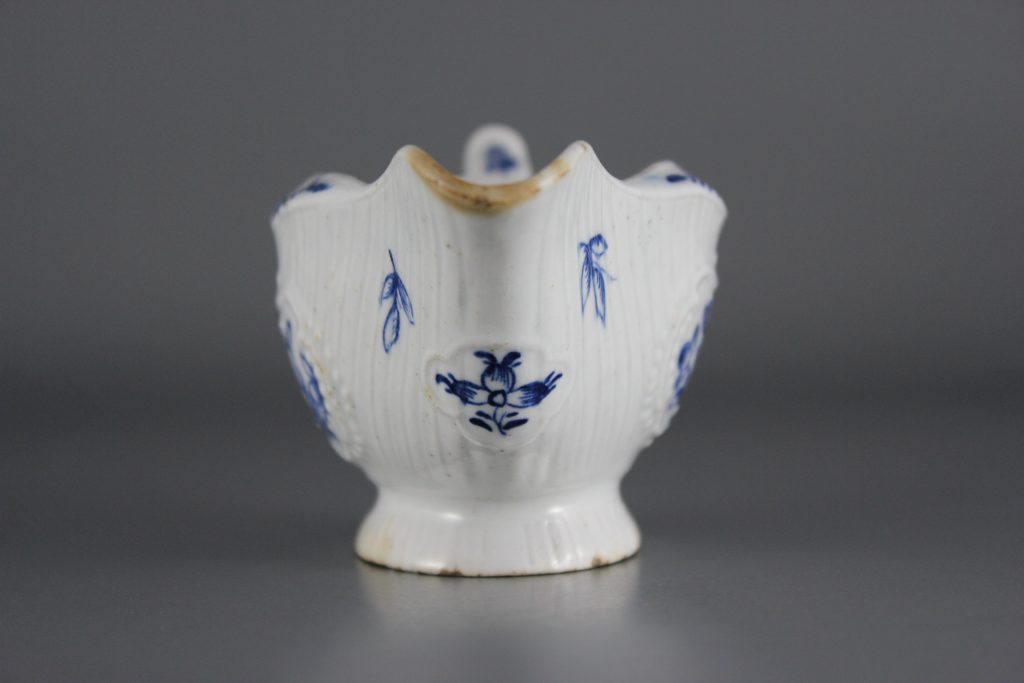
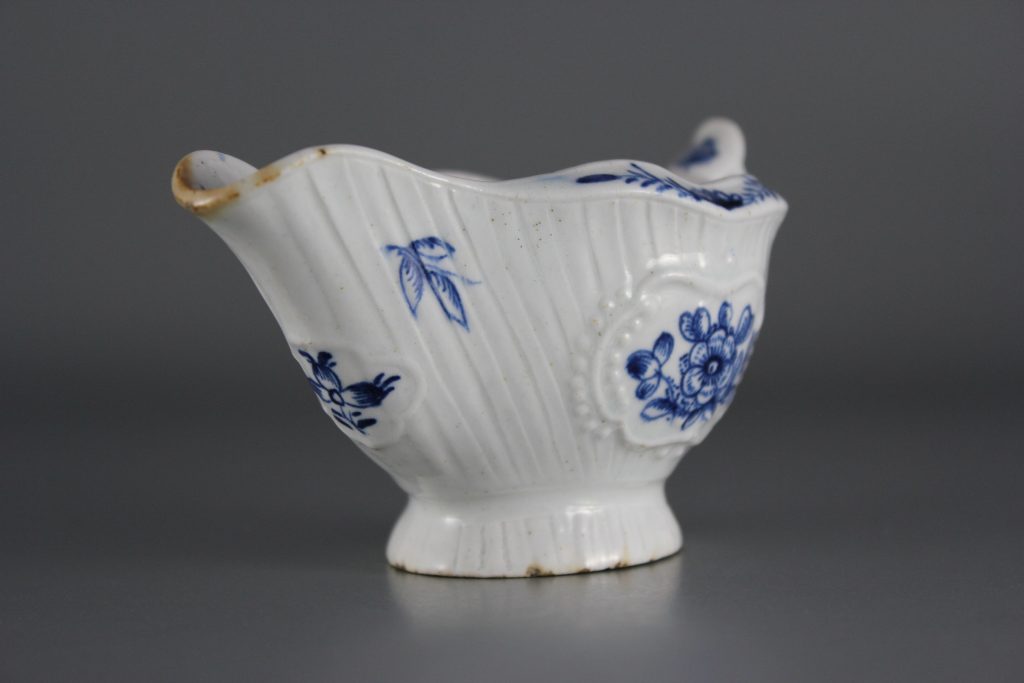
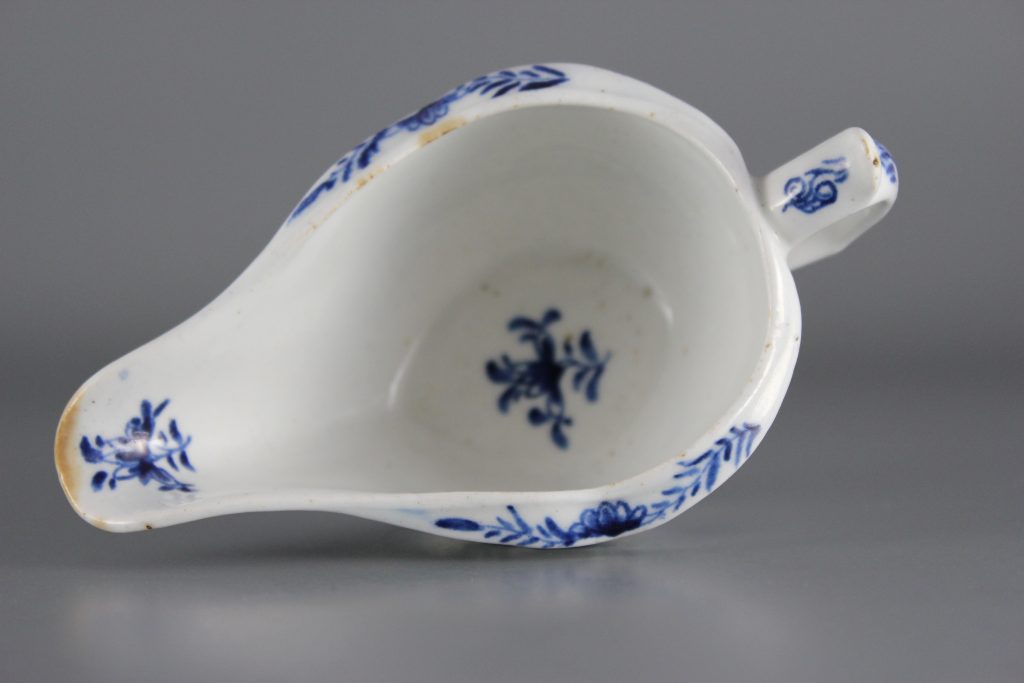
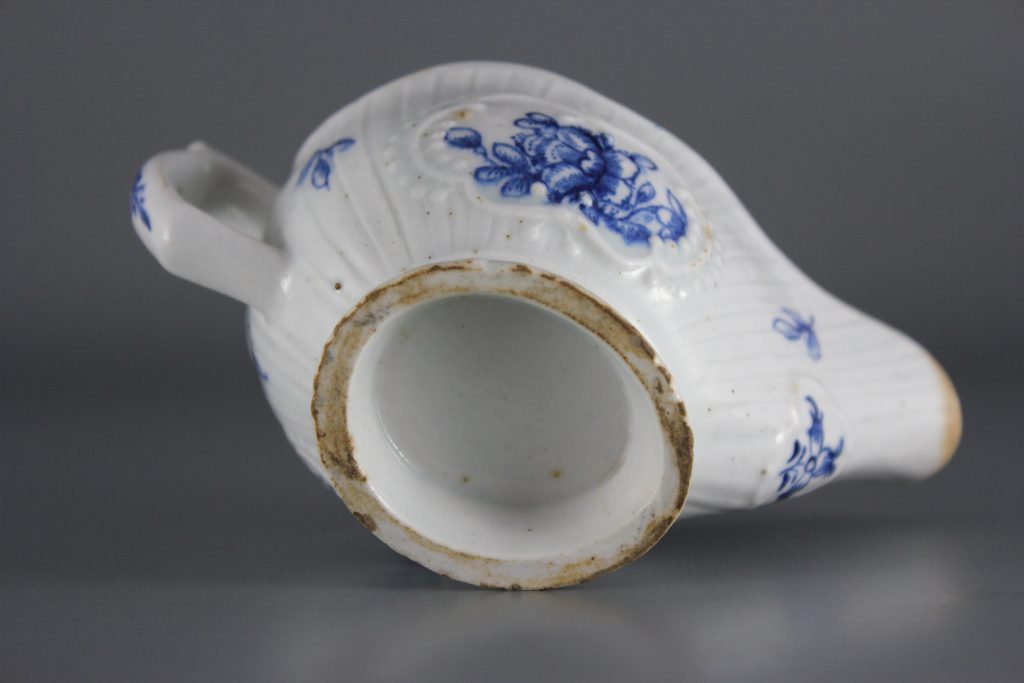
An interesting English porcelain Creamboat, possibly Isleworth, circa 1765-75
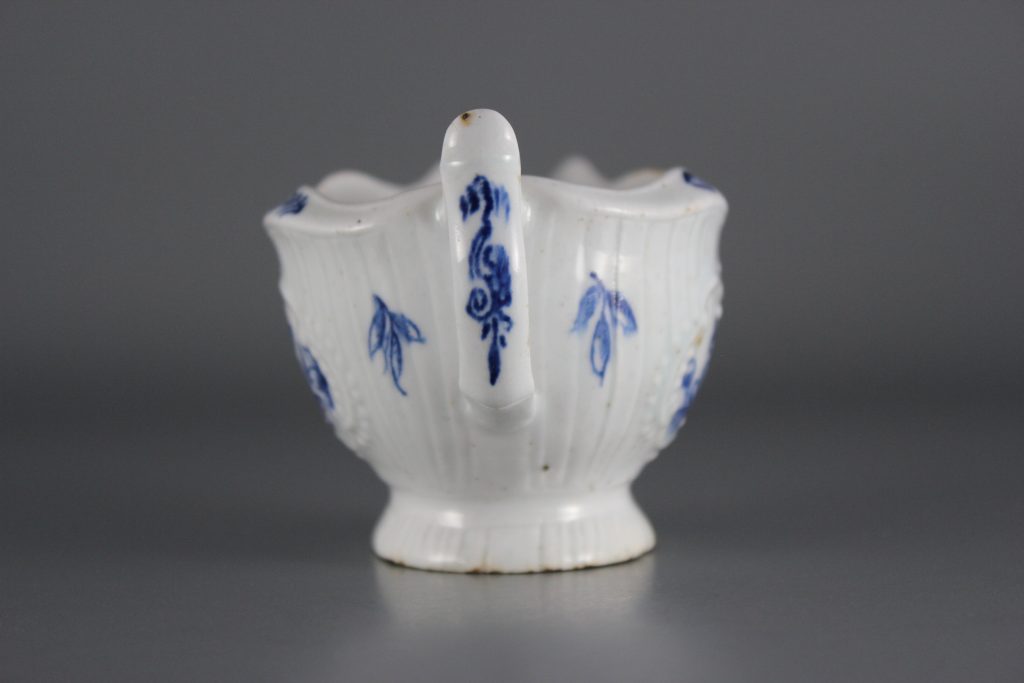
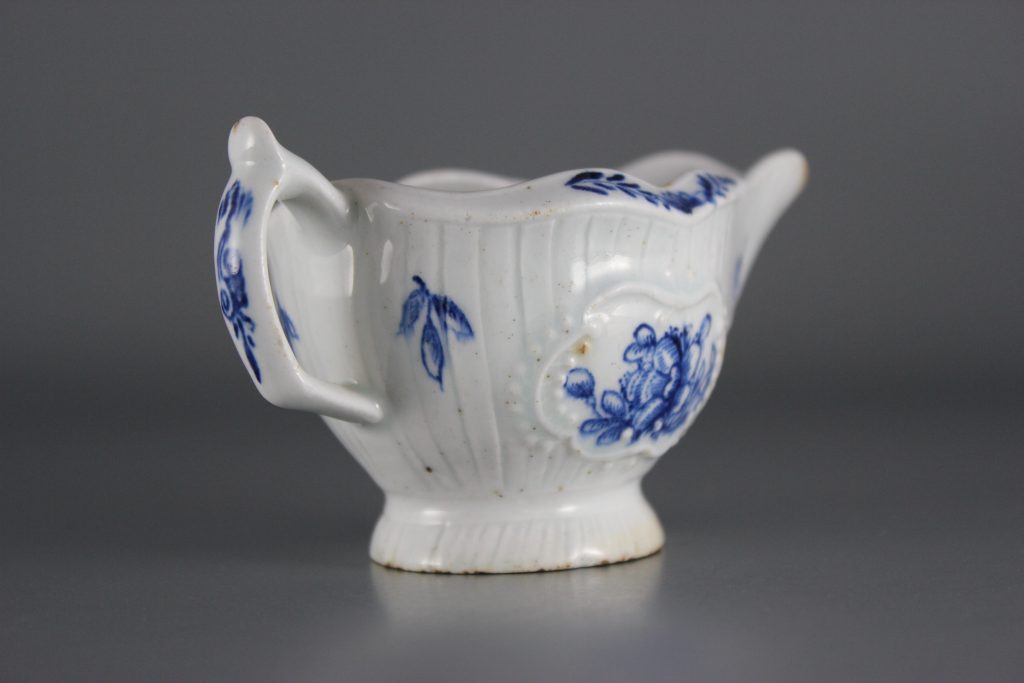
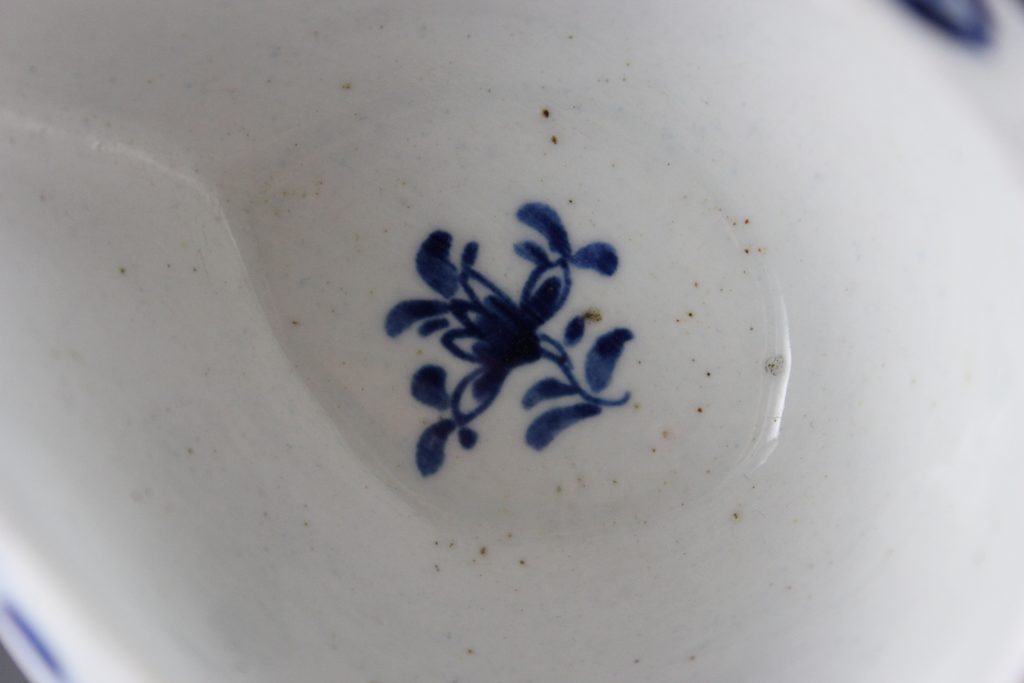
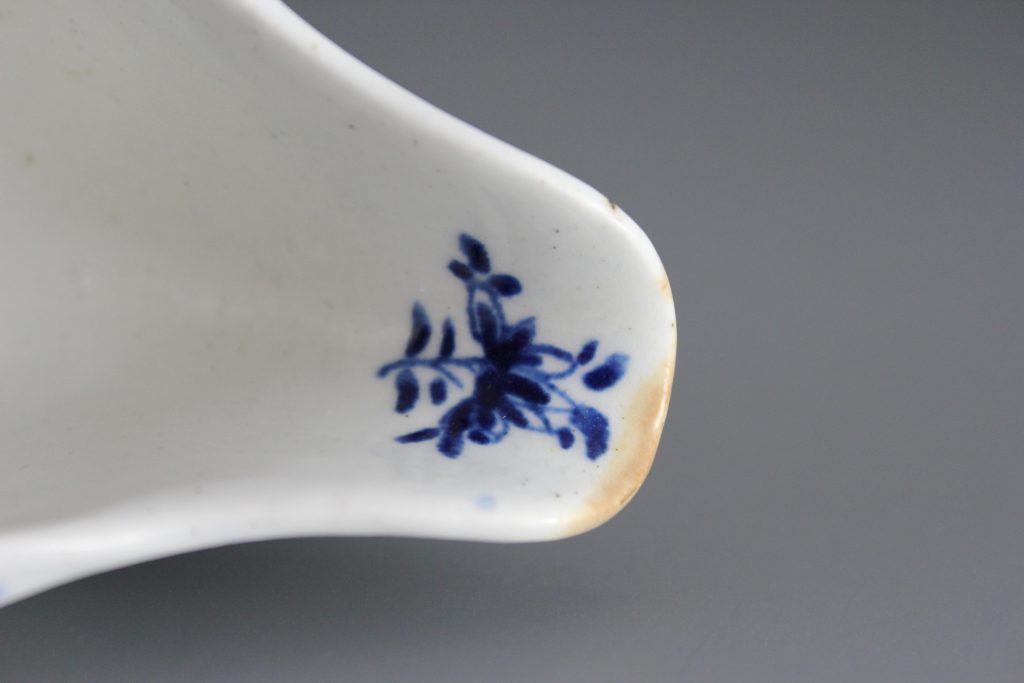
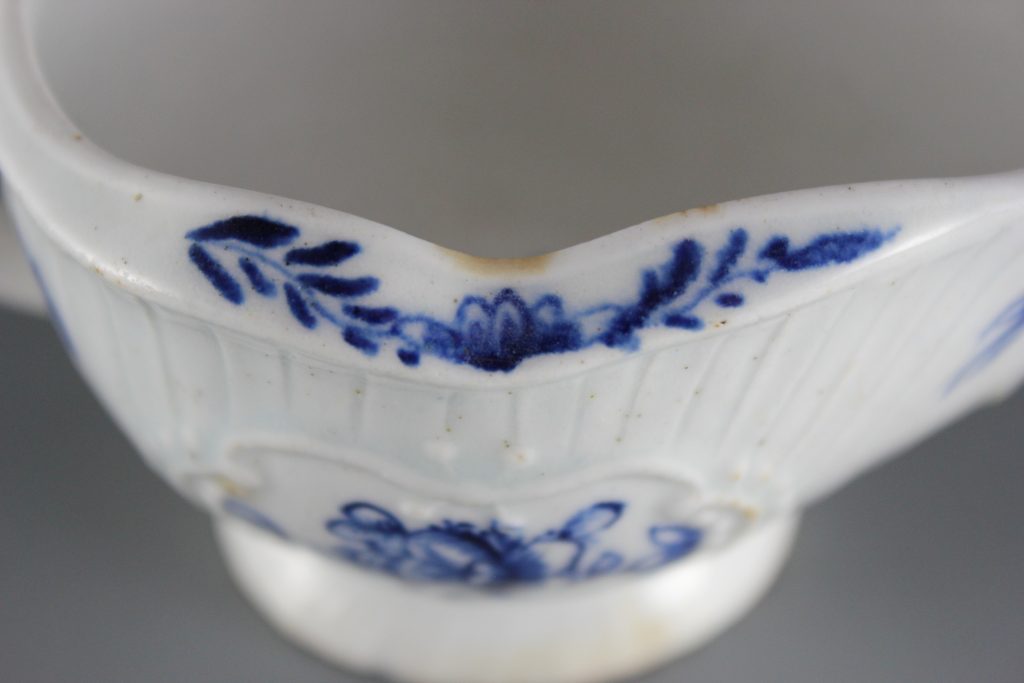
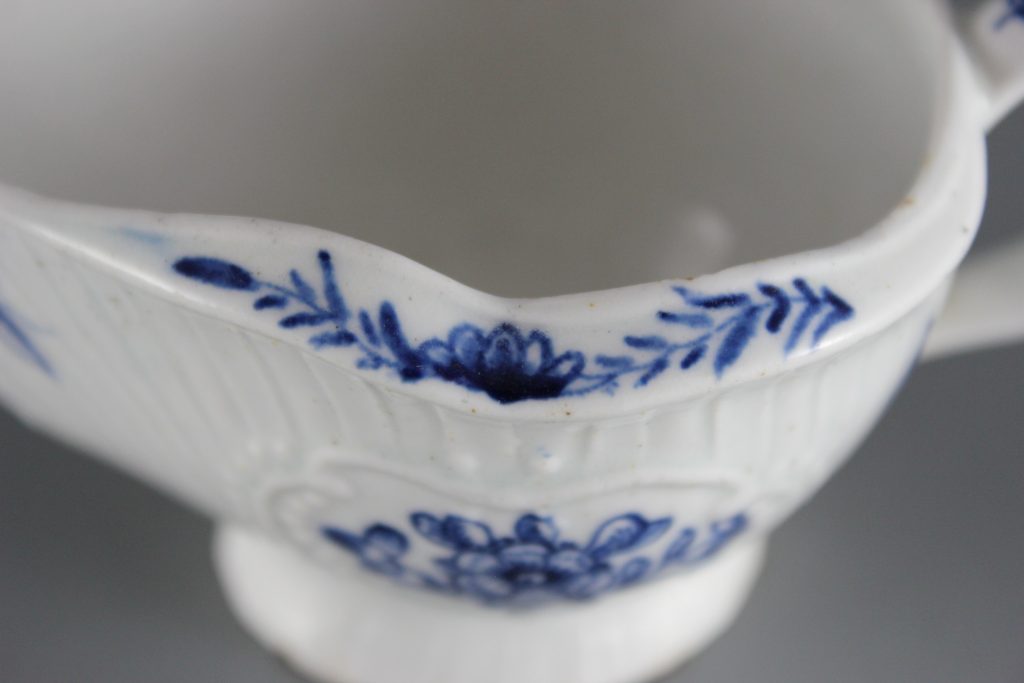
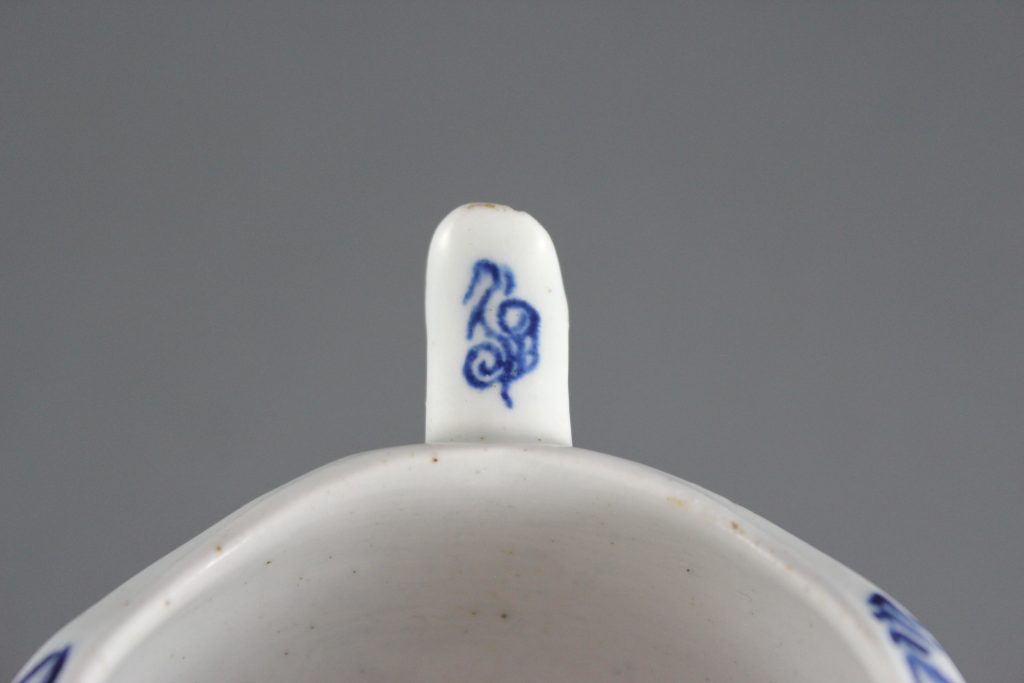
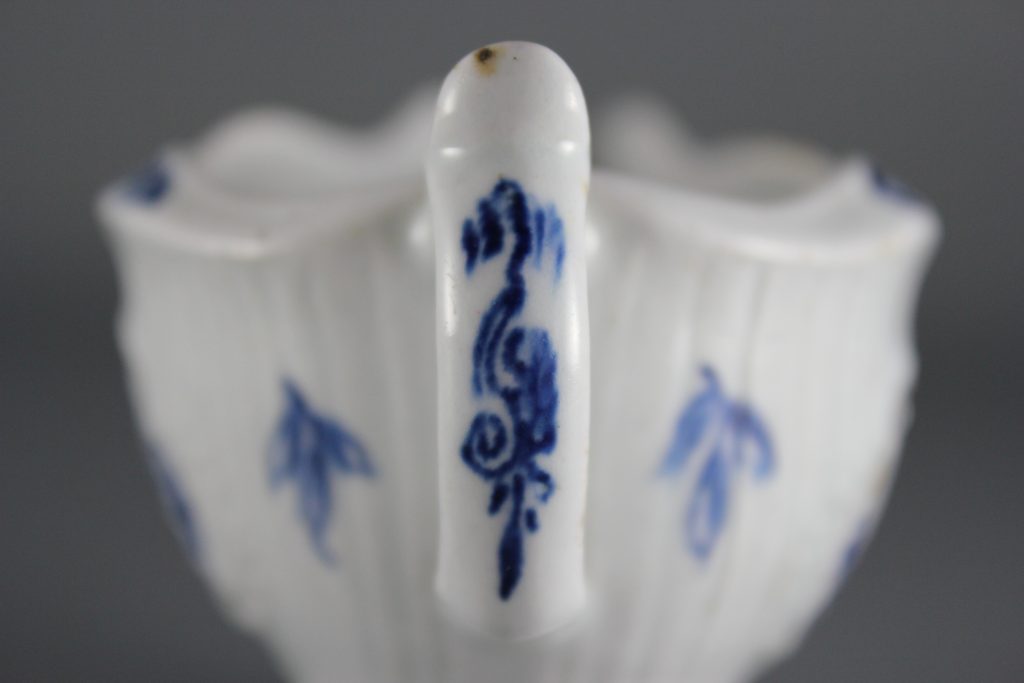
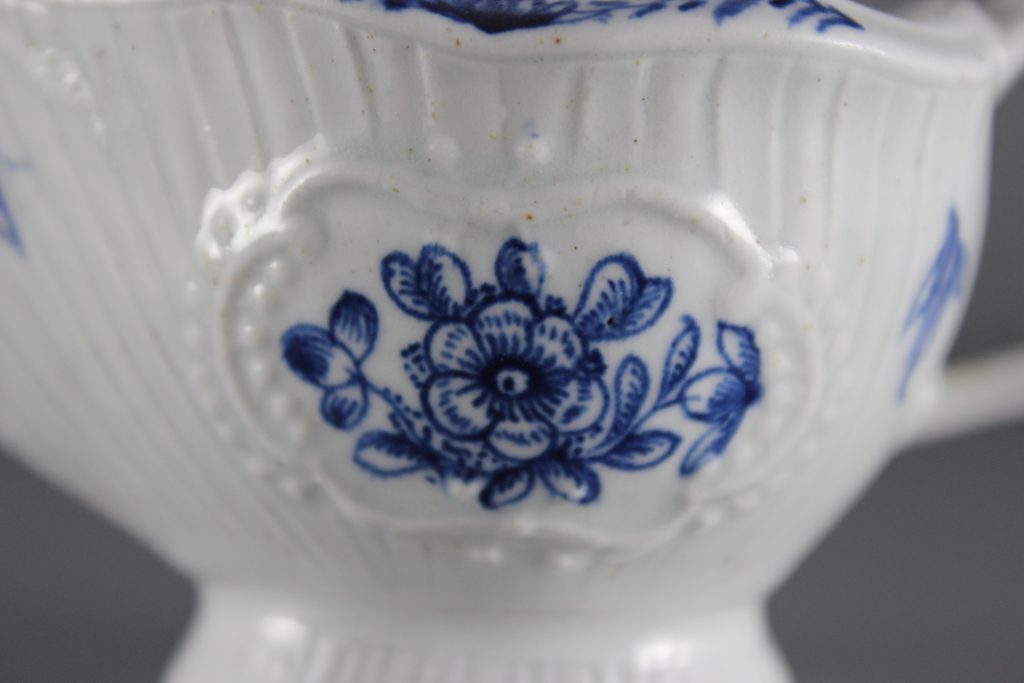
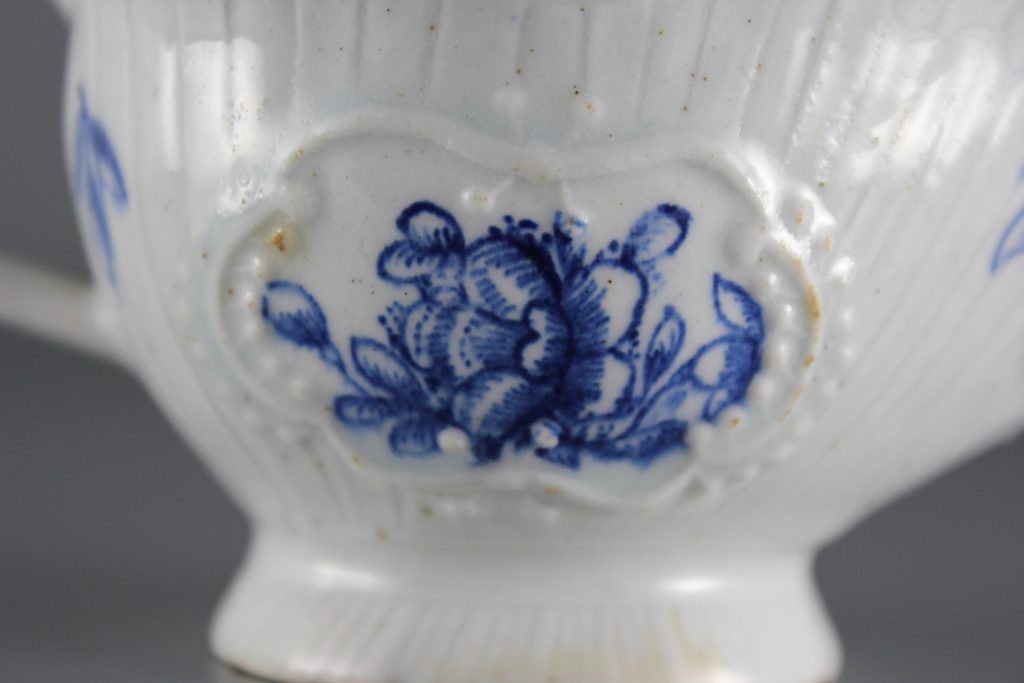
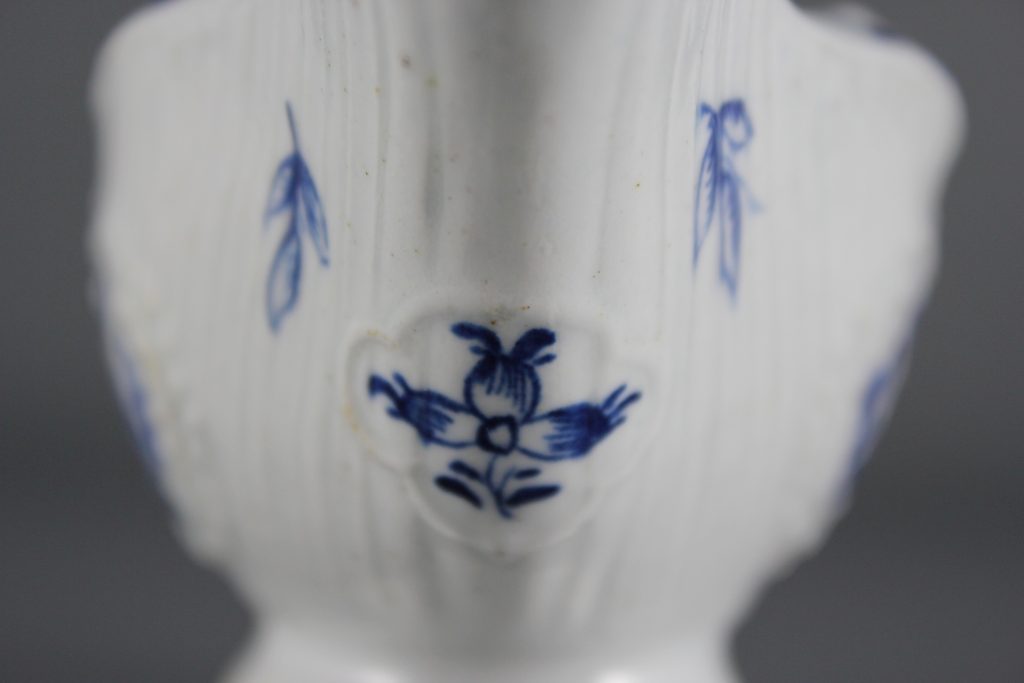
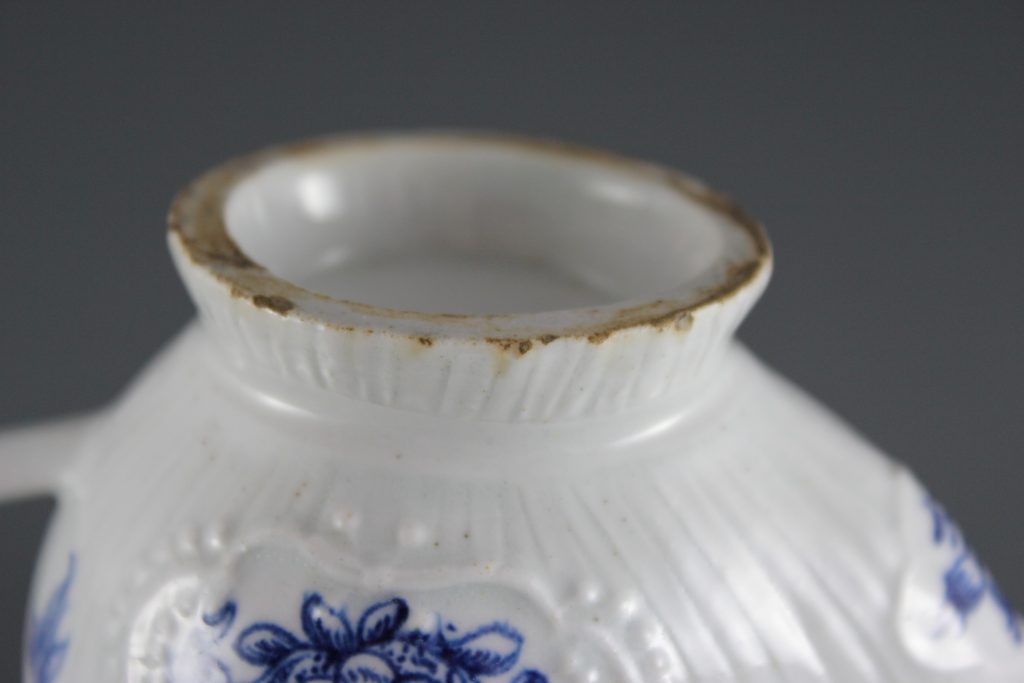
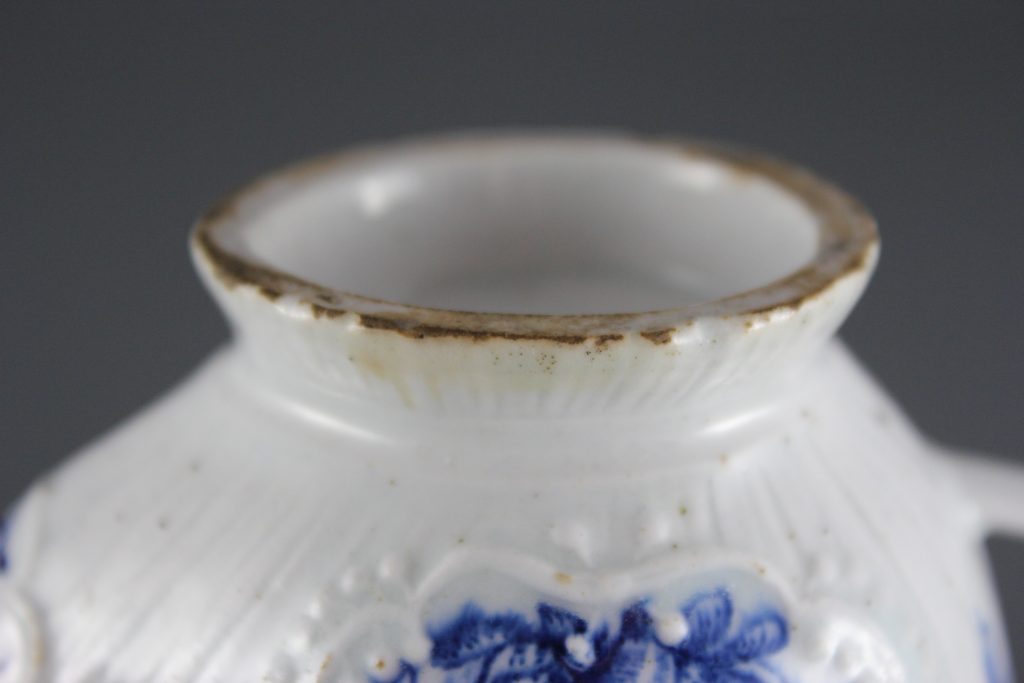
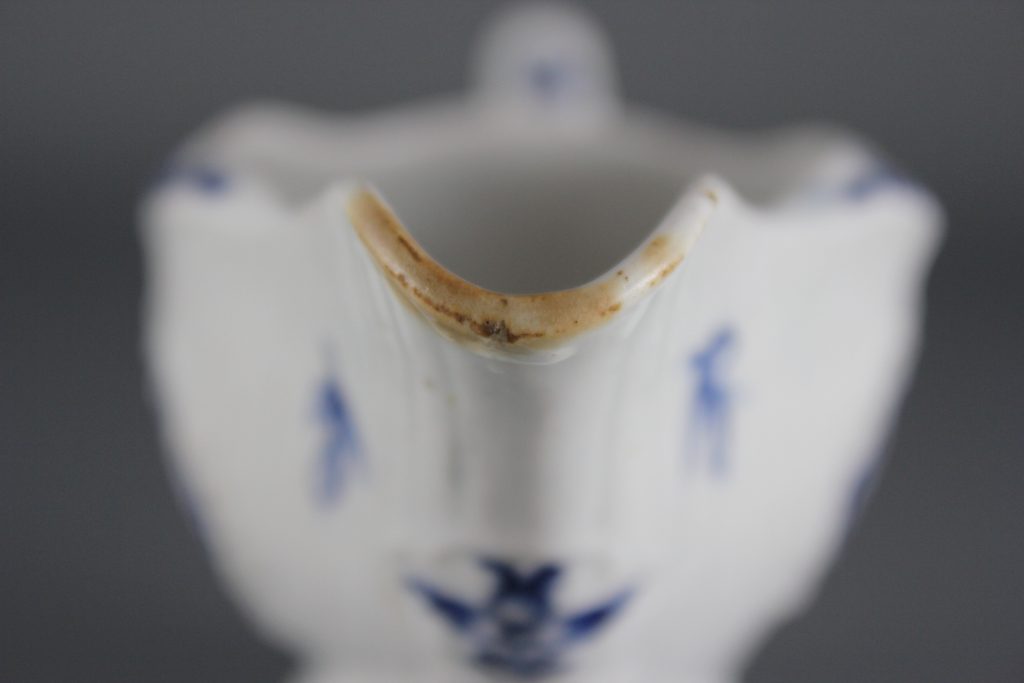
This pleat-moulded pedestal creamboat is decorated with two relief-moulded cartouches containing flower sprays, painted in underglaze blue. A small cartouche beneath the pouring lip contains a single flower. The remainder of the exterior is painted with scattered leaves. The interior base is painted with a small sprig. The pouring lip is painted with a similar sprig. The inverted rim is painted in underglaze blue with a trailing floral design and the handle is painted with scroll motifs.
Although not unique to Isleworth, the shape of this creamboat, with its inverted rim, handle type, and pedestal foot is certainly known to have been made there. The deep pedestal base is of special interest as it seems to have only been used at Isleworth. The use of parallel shading on the leaves and flowers has particularly close similarities to Isleworth painting. It also exhibits characteristics typical of Isleworth porcelain, including relatively poor translucency. The identity of the maker is presently unknown, but combined with the science, Isleworth would appear to be the strongest candidate at present.
Unmarked.
Provenance: Private Collection, London.
Both the glaze and underglaze cobalt blue pigment of this piece have been tested using X-Ray Fluorescence Spectroscopy (XRF). The results, published in the English Ceramic Circle Transactions, vol. 28, 2017, reveal that the cobalt blue contains nickel. This is significant as 10 out of 10 of all confirmed Isleworth pieces contain nickel, as do all 36 of the possible Isleworth pieces tested. Compare this with the results for Bow, where no nickel is present in the cobalt blue pigment.
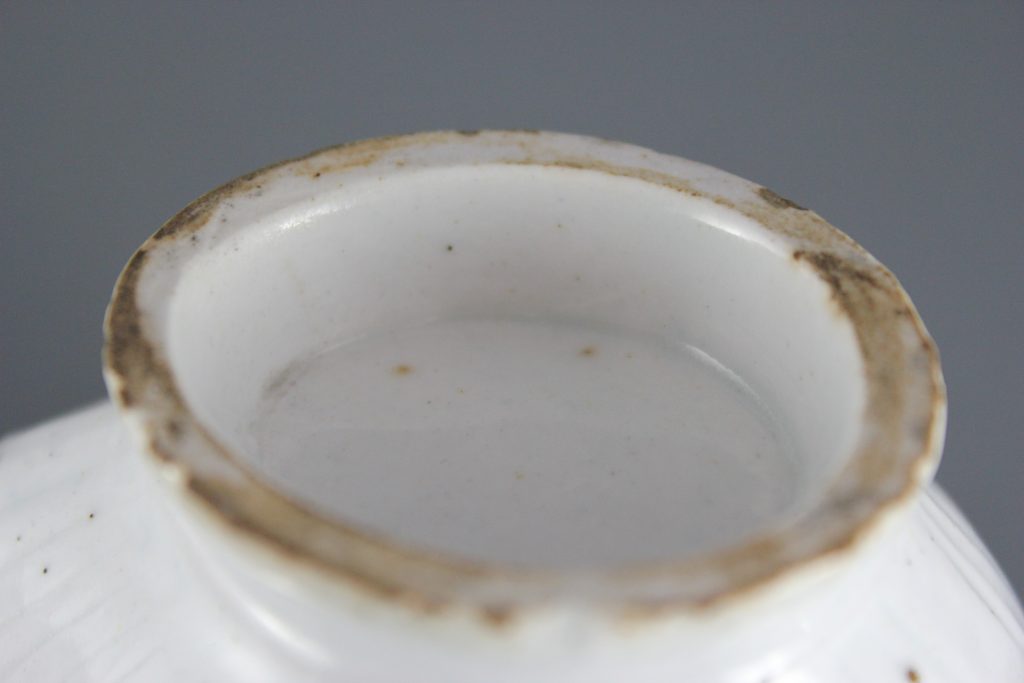
Condition: There are a few patches of light glaze wear and staining, including to the pouring lip, the rim and also the foot rim. There are also a few tiny chips to the foot rim. No cracks and no restoration. There is a tiny pinhole to the thumbrest from manufacture, and also typical glazing and firing impurities and imperfections, including a glazed chip on the foot rim.
Dimensions: Length 12.5 cm; Height (to top of thumbrest) 6.5 cm
Transactions, vol. 28 (English Ceramic Circle, 2017). See the entry for item no. 2015-04 100, page 21.
Isleworth Pottery and Porcelain: recent discoveries, compiled by Roger Massey, Jacqueline Pearce and Ray Howard (English Ceramic Circle and Museum of London, 2003).
Godden’s Guide to Blue and White Porcelain, Geoffrey A. Godden (Antique Collectors’ Club, 2004).
British Porcelain Sauceboats of the 18th Century, Nicholas Panes (Gomer Press, 2009).
Ref. For three sauceboats of this form and with the same moulded cartouches, see British Porcelain Sauceboats of the 18th Century, where N. Panes attributes them possible Isleworth (pp.220-221).